Net Billing in Ukraine: How the New Energy Offset System Works
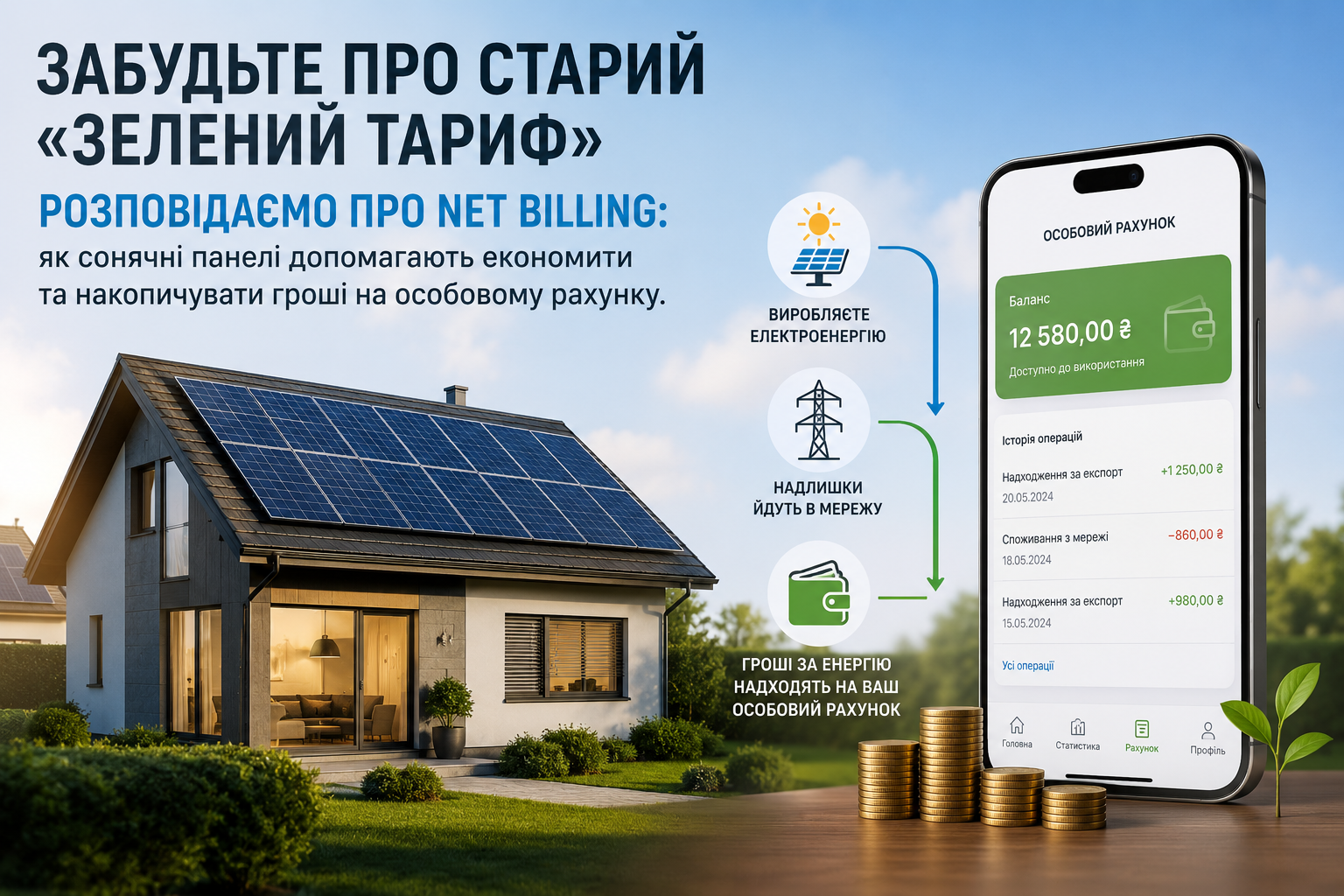
Net Billing in Ukraine: How the New Solar Energy System Works in 2026
Ukraine’s solar energy market is gradually shifting away from the classic “Green Tariff” model toward a more modern and flexible system called Net Billing.
Instead of focusing on selling electricity to the state at a fixed price, the new approach prioritizes self-consumption and efficient use of generated solar energy.
For homeowners and businesses, this often turns out to be more practical and stable, especially considering rising electricity prices, power outages, and the cost of battery storage systems.
Let’s break down how Net Billing works in Ukraine, who benefits most, and what you need to know before installing a solar power system.
What Is Net Billing?
Net Billing is a system where excess electricity produced by your solar power system is fed into the grid, and its value is credited to your account in Ukrainian hryvnia (UAH).
In simple terms:
- during the day, solar panels generate electricity;
- you use part of it directly;
- surplus energy is sent to the grid;
- you receive financial compensation for it;
- this balance is later used to pay for electricity consumed at night or during winter.
In other words, the grid acts like a “virtual battery.”
Net Billing vs. the Green Tariff
Many people still confuse these two systems.
Green Tariff (older model)
The previous system worked like this:
- you sold electricity to the state;
- the state purchased it at a fixed tariff;
- you received direct monetary payments.
At the time, this was highly attractive, but it had drawbacks:
- strong dependence on government regulation;
- payment delays;
- administrative complexity;
- higher pressure on the energy system.
Net Billing (modern model)
Net Billing works differently:
- you don’t directly “sell” electricity in the traditional sense;
- instead, you offset your own consumption;
- you accumulate a monetary balance in UAH;
- this balance reduces future electricity bills.
This makes Net Billing more stable and aligned with modern decentralized energy systems.
How Net Billing Works in Practice
A typical daily cycle for a household with solar panels looks like this:
1. Solar generation
During the day, panels supply electricity to:
- refrigerator;
- air conditioner;
- water pumps;
- computers;
- household appliances.
At this stage, you mostly avoid drawing energy from the grid.
2. Excess energy is exported to the grid
If your system produces more than you consume, the surplus is automatically sent to the distribution operator through a bidirectional meter.
3. You receive a financial credit
The electricity supplier calculates the exported energy and credits your account.
Important note:
In Net Billing, accounting is done in money (UAH), not kilowatt-hours.
The compensation price is usually tied to the wholesale electricity market (day-ahead market), meaning it can fluctuate over time.
4. Energy balance is used later
In the evening or winter, when solar production drops, you consume electricity from the grid.
This consumption is partially or fully covered by your accumulated credit.
Why Net Billing Became Especially Relevant After Power Outages
After widespread power outages in Ukraine, solar energy became much more than just a financial tool.
Previously, the main goal was:
“earn money from generation.”
Now it is:
- energy independence;
- bill reduction;
- backup power capability;
- resilience during outages.
This is why Net Billing works well together with hybrid inverters and battery storage systems.
During the day, the house runs on solar energy, excess is exported to the grid, and batteries are used only as backup during outages.
Do You Need Batteries Under Net Billing?
Not necessarily.
This is one of the main advantages of the system.
The grid effectively acts as a “virtual storage system”:
- you export excess energy during the day;
- you consume it later via financial credit.
However, there is an important limitation:
during a blackout, a standard grid-tied solar system without batteries typically does not operate.
Therefore, if backup power is needed, the system usually includes:
- hybrid inverter;
- LiFePO4 battery storage;
- critical load circuit.
Who Benefits Most from Net Billing?
Residential users
Net Billing is especially beneficial for homes with:
- high daytime consumption;
- air conditioning usage;
- heat pumps;
- electric vehicle charging;
- electric heating systems.
In many cases, this significantly reduces monthly electricity bills.
Businesses
For commercial users, the system is often even more efficient.
Offices, shops, warehouses, and production facilities consume most of their electricity during daytime hours — exactly when solar generation is highest.
As a result, solar systems can:
- directly cover daytime demand;
- reduce grid dependency;
- significantly lower operational costs.
For many businesses, solar ROI is now comparable or even better than under the old Green Tariff model.
Technical Requirements
To participate in Net Billing, you typically need:
- a solar power system;
- a bidirectional electricity meter;
- a contract with an electricity supplier;
- grid connection approval;
- a grid-tied or hybrid inverter.
In some cases, remote metering systems may also be required.
Is Net Billing Already Fully Implemented in Ukraine?
Ukraine has already adopted the legal framework for prosumers and Net Billing mechanisms, but some practical and regulatory details are still being refined and implemented in stages.
As a result, actual conditions may vary depending on:
- regional distribution operators;
- electricity suppliers;
- technical requirements for metering equipment.
Before installing a system, it is important to confirm:
- current connection rules;
- equipment requirements;
- meter type;
- availability of the mechanism in your region.
What About Taxes?
This is an area where misinformation often appears online.
In some cases, Net Billing is described as completely tax-free, but in practice the taxation depends on the legal structure and the way compensation is handled.
If excess electricity is monetized as a financial credit or payment, tax implications may apply depending on the consumer status and contractual setup.
For this reason, it is recommended to consult:
- your electricity provider;
- an accountant;
- a tax advisor.
Especially if the system is registered under a business or sole proprietorship.
Why Net Billing Is the Future of Solar Energy
The global energy system is gradually shifting from:
“centralized power plants → passive consumers”
to:
“millions of active prosumers with distributed generation.”
Net Billing is designed exactly for this model.
A household or business is no longer just a consumer — it becomes part of the energy ecosystem.
With:
- rising electricity prices;
- frequent grid instability;
- decreasing solar panel costs;
- improving battery technology;
solar systems are no longer an alternative — they are becoming a rational infrastructure investment.
Conclusion
Net Billing is a modern solar energy model focused not on selling electricity, but on maximizing self-consumption and efficiency.
For households, it means:
- lower electricity bills;
- partial energy independence;
- better use of solar generation.
For businesses, it means:
- reduced operating costs;
- improved energy stability;
- better long-term predictability.
Most importantly, it aligns with how modern energy systems are evolving — decentralized, flexible, and consumer-driven.